
Among the images that define an architectural portfolio, few carry the same quiet authority as the twilight exterior. It is the frame that lingers in memory: a building glowing from within, set against a sky that has not quite surrendered the day. For architects, builders, and hoteliers, it is often the single photograph that travels furthest, appearing on covers, homepages, and award submissions. Yet it is also one of the most misunderstood images to make, because it depends on a window of time that is far shorter and far more exacting than most people expect.
What the Twilight Shot Actually Captures
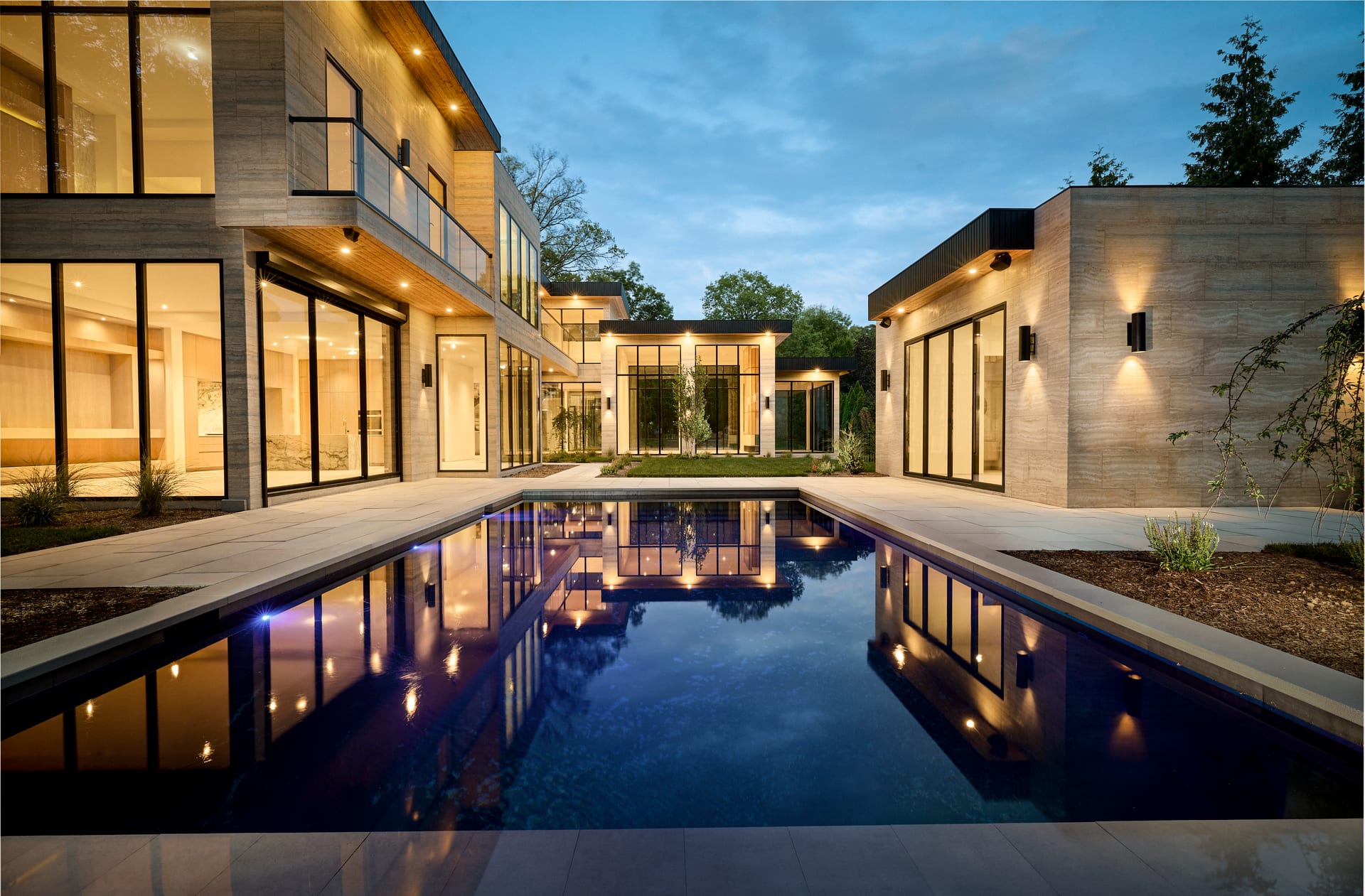
The twilight exterior is not a photograph of a building at night. It is a photograph of balance. For a brief interval after sunset, the fading daylight and the artificial light inside a structure reach a point of near equality. The sky holds enough color to describe the form against it, while the interior lighting reads as warm, inhabited, and alive. Shoot too early and the windows disappear into a bright sky. Shoot too late and the building becomes a black silhouette punctured by hot, overexposed glass.
This equilibrium is what gives the image its depth. The architecture is legible in three dimensions, the glazing becomes a lantern rather than a void, and the whole composition acquires a sense of occasion. In architectural photography, this is the moment when a structure stops being a record and starts being a portrait.
The twilight exterior is not a photograph of a building at night; it is a photograph of balance.
The Window Is Shorter Than You Think
The usable light for a twilight shot rarely lasts more than twenty to thirty minutes, and the very best of it may be only ten. As the sun drops below the horizon, the sky moves through a sequence of tones, from pale gold to deep cobalt, and the exterior ambient light falls steadily while the interior lighting stays constant. There is a single moment where those two values cross. Everything before and after it is a compromise.
Because that window is so narrow, the twilight shot cannot be improvised. It is the product of preparation that begins hours earlier. The composition must be locked, the tripod positioned, exposure and focus resolved, and every variable that can be settled in advance must be settled before the light arrives. When the sky begins to turn, there is no time left for decisions.
Preparing the Interior
The success of an exterior twilight image depends heavily on what happens inside the building. Interior lighting is the content of the glass, and it must be managed with the same care as any interior photography assignment.
- Switch on every light that reads through the glazing, and turn off any that create unflattering hotspots or color clashes.
- Draw blinds and curtains to a consistent position so the facade reads as one coherent surface rather than a patchwork.
- Mind the color temperature of interior sources, since a mix of warm and cool lamps can make the windows look restless.
- Remove or reposition anything inside that would appear as a distracting shape behind the glass.
For a boutique hotel, this is often where the image is won or lost. A lobby that glows with even, considered light will carry the entire frame, while a single dark room can leave a gap that the eye cannot ignore.
Reading the Sky and the Site
No two twilights are the same, and the quality of the sky determines how much latitude the photograph allows. A clear evening offers a clean, graduated backdrop but a faster fall of light. A sky with scattered high cloud can hold color longer and lend texture to the upper frame, which often flatters a building. Heavy overcast flattens the whole scene and shortens the window further, though it is not without its own restrained appeal.
Orientation matters as much as weather. A facade facing the afterglow will be gently lit by the sky itself, while a facade facing away sits in shadow and relies almost entirely on its own illumination. Scouting the site at the right time of day, and understanding where the sun sets relative to the building, tells you which elevation will reward the effort. This is the kind of groundwork that separates a considered architectural image from a lucky one.
When the sky begins to turn, there is no time left for decisions.
The Blend of Exposures
Because the brightness range at twilight is extreme, a single exposure rarely holds both the glowing interior and the subtle detail of the darkening facade. The reliable approach is to capture a sequence of frames across the transition, from the stronger ambient light of early dusk to the deeper blue later on, and to combine them with restraint.
The intention is not to manufacture a scene that never existed. It is to reconstruct what the eye perceived across those minutes, when it adapted continuously to the changing light. A convincing twilight photograph should feel like a single honest moment, not a composite of competing exposures. The material truth of the building, the color of its finishes, and the geometry of its lines must survive the blend intact.
Keeping the Architecture Honest
It is tempting to push a twilight image toward spectacle, saturating the sky and flooding the glass with warmth. The more lasting result comes from discipline. Verticals should still stand true, the sky should retain a natural gradient rather than an electric one, and the interior glow should read as hospitality rather than theatre. The goal is a photograph that an architect would recognize as their work and a designer would recognize as their palette.
When the Twilight Shot Is Worth It
Not every project calls for a twilight exterior. A daylight image often serves better when the aim is to show material, context, and the relationship between a building and its surroundings. The twilight shot earns its place when a structure has a strong silhouette, generous glazing, or a lighting scheme that deserves to be seen. For hotels, restaurants, and residences where atmosphere is part of the offer, it can be the defining frame of an entire set.
Approached with patience, the twilight exterior rewards the effort many times over. It is a collaboration between architecture, interior lighting, and a sky that performs for only a few minutes. Plan for it, prepare the interior, and be standing in position before the color arrives, and you capture a building at the precise moment it looks most like itself.
If you are planning to photograph a project where the twilight hour could do it justice, I would welcome the conversation at Matthew Lekker Photography.
Add us as a preferred source on Google
Add as preferred source