The Trouble and the Gift of Reflective Surfaces
Few elements test a photographer quite like glass. A curtain wall, a mirrored powder room, a lacquered kitchen island, a glazed shopfront at street level. Reflective surfaces are everywhere in contemporary design, and they behave in ways that ordinary materials do not. They do not simply receive light; they return it, redirect it, and sometimes reveal things you would rather keep out of frame. For architects, interior designers, and hoteliers, these are often the most expressive materials in a space. In architectural photography, they are also the most demanding.
The instinct, when confronted with a reflection, is to treat it as a defect. A camera visible in a mirror, a window that catches the sky as a flat white rectangle, a glossy floor that doubles the room in an unhelpful way. Yet reflection is not noise to be removed. It is information about the space, and when handled with intention it becomes one of the most rewarding parts of the image.
Reflection is not noise to be removed; it is information about the space, waiting to be composed rather than corrected.
Understanding What a Surface Actually Does
Before solving a reflection, it helps to read it. Every reflective material has a character. A large sheet of clear glazing is close to a perfect mirror at shallow angles and nearly invisible when viewed straight on. Brushed metal scatters light into a soft, directional smear. Polished stone holds a reflection but softens its edges. Mirror, of course, returns everything with full fidelity, including the photographer.
The single most useful principle is the angle of incidence. What a surface reflects depends entirely on where you stand and how the surface is oriented. Move a step to the left and the glass that was showing a blown-out window now shows the warm interior beyond it. This means that most reflection problems in interior photography are not lighting problems at all. They are position problems, solved by the camera rather than by additional equipment.
Glazing and Windows
A large window is both a light source and a mirror. During the day it can read as a bright void that pulls the eye away from the room. The most honest approach is often to expose so that the view beyond retains some detail, then to balance the interior in the edit. This requires bracketing several exposures and blending them with restraint, keeping the relationship between inside and outside believable. A window that shows a soft, legible garden anchors a room. A window rendered as pure white erases the connection between the space and its setting.
Mirrors
Mirrors are the most literal challenge because the camera, the tripod, and the photographer can all appear in them. The solutions are practical and worth knowing:
- Shoot from an angle where the mirror reflects a considered part of the room rather than the equipment.
- Use the reflection deliberately, allowing the mirror to reveal a feature otherwise hidden from the frame.
- Where a camera intrusion is unavoidable, capture a clean reference frame from a shifted position to reconstruct the surface cleanly in post.
A mirror well handled can double the sense of depth in a compact room, which is why they matter so much in hospitality interiors and smaller residential spaces.
Polished Floors and Countertops
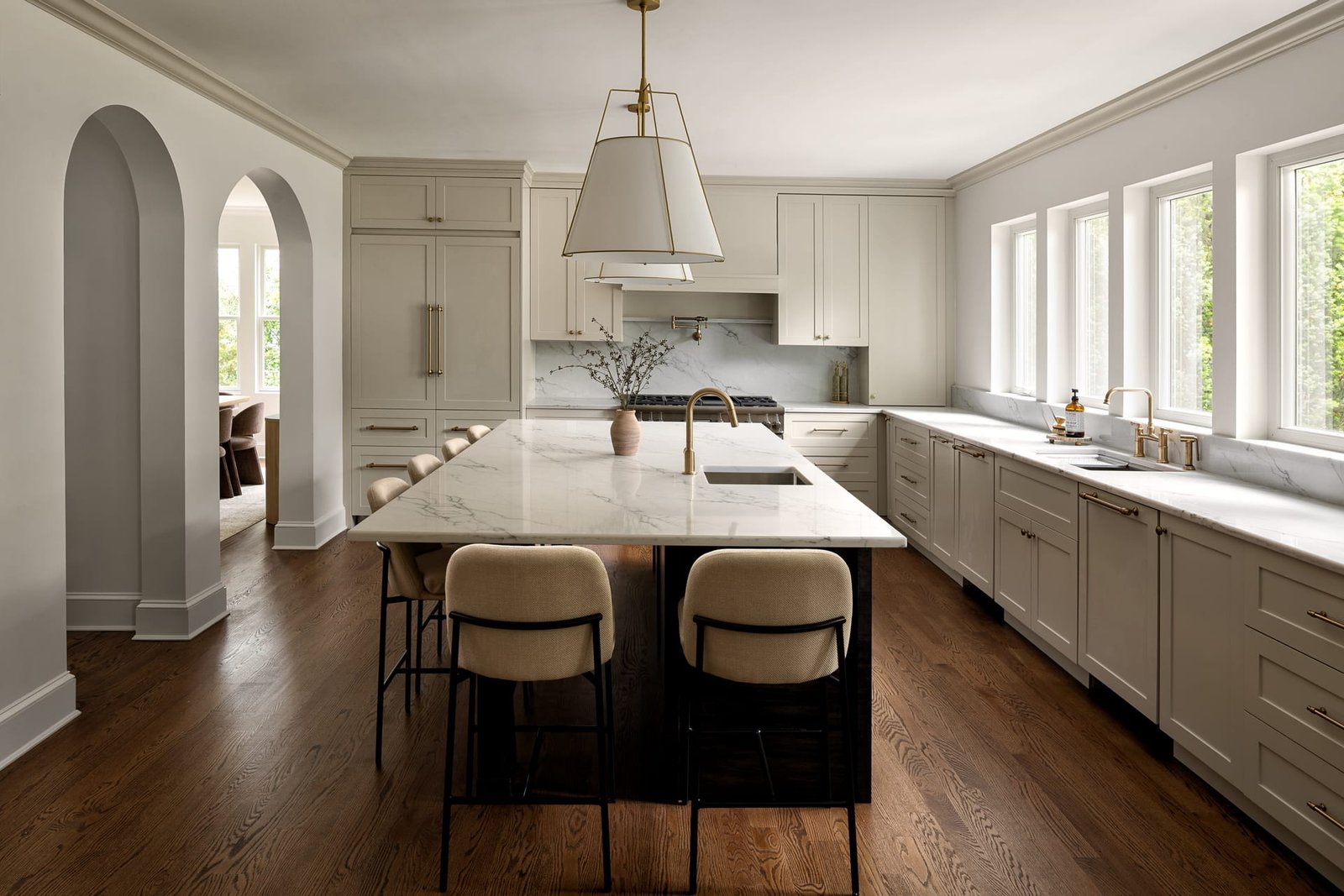
Glossy floors and high-sheen stone act as horizontal mirrors. They can be a liability, reflecting an unlit ceiling or a cluttered corner, or an asset, carrying the glow of a pendant light or the shape of a window across the room. The difference lies in what sits above them. Before pressing the shutter, look at the ceiling and the upper walls, because that is what a polished floor will show.
Working With Light Rather Than Against It
Reflective materials are unusually sensitive to the quality of light around them. Hard, direct light produces sharp, distracting hotspots on glass and metal. Soft, diffused light spreads across the same surface as a gentle gradient that reads as luxurious rather than harsh. This is one reason overcast days can be a quiet advantage for spaces dominated by glazing and gloss.
Natural light also changes the story a surface tells. A glass partition in the morning may reflect a cool north sky; by late afternoon it may glow with warmth. Understanding these shifts allows the photographer to schedule the most reflective elements for the moment they behave best, in the same way a designer specifies a finish for the light it will live in.
A polished floor shows you the ceiling, so the composition is decided long before the shutter is pressed.
What Design Professionals Can Do Before the Shoot
Much of the outcome is set before the camera arrives, and the preparation of reflective surfaces is a shared responsibility. A few considerations make a measurable difference:
- Clean glass and mirrors thoroughly, since fingerprints and streaks are magnified by the lens and tedious to remove afterward.
- Polish metal fixtures and remove dust from high-sheen surfaces, as these collect specular highlights.
- Consider what will be reflected, not only what will be photographed. A beautiful mirror facing an untidy corner will simply document the corner.
- Flag any surface that is central to the design so it can be given the time and angle it deserves.
For hoteliers and interior designers in particular, reflective materials are frequently the signature of a scheme, the marble, the mirrored bar, the floor-to-ceiling glazing that frames a view. Treating these as priorities in planning, rather than incidental backdrops, ensures they are captured with the care they were designed to command.
The Editorial Restraint of a Clean Reflection
The final image should feel effortless, which usually means a great deal of quiet decision-making has gone unseen. A well-photographed reflection does not announce itself. It simply looks right, in the way a room looks right when the light falls where it should. The goal is never to eliminate reflection entirely, which produces flat and lifeless surfaces, but to shape it so it supports the composition and honors the material.
This is where architectural and interior photography becomes an act of interpretation rather than mere documentation. Glass and mirror ask the photographer to think three-dimensionally, to account for the whole room even when framing a single corner, and to respect the intentions of the designer who chose those materials in the first place.
If you are preparing to photograph a space where glass, mirror, or polished finishes play a leading role, we would be glad to talk it through with you at Matthew Lekker Photography.