What We Mean by Depth
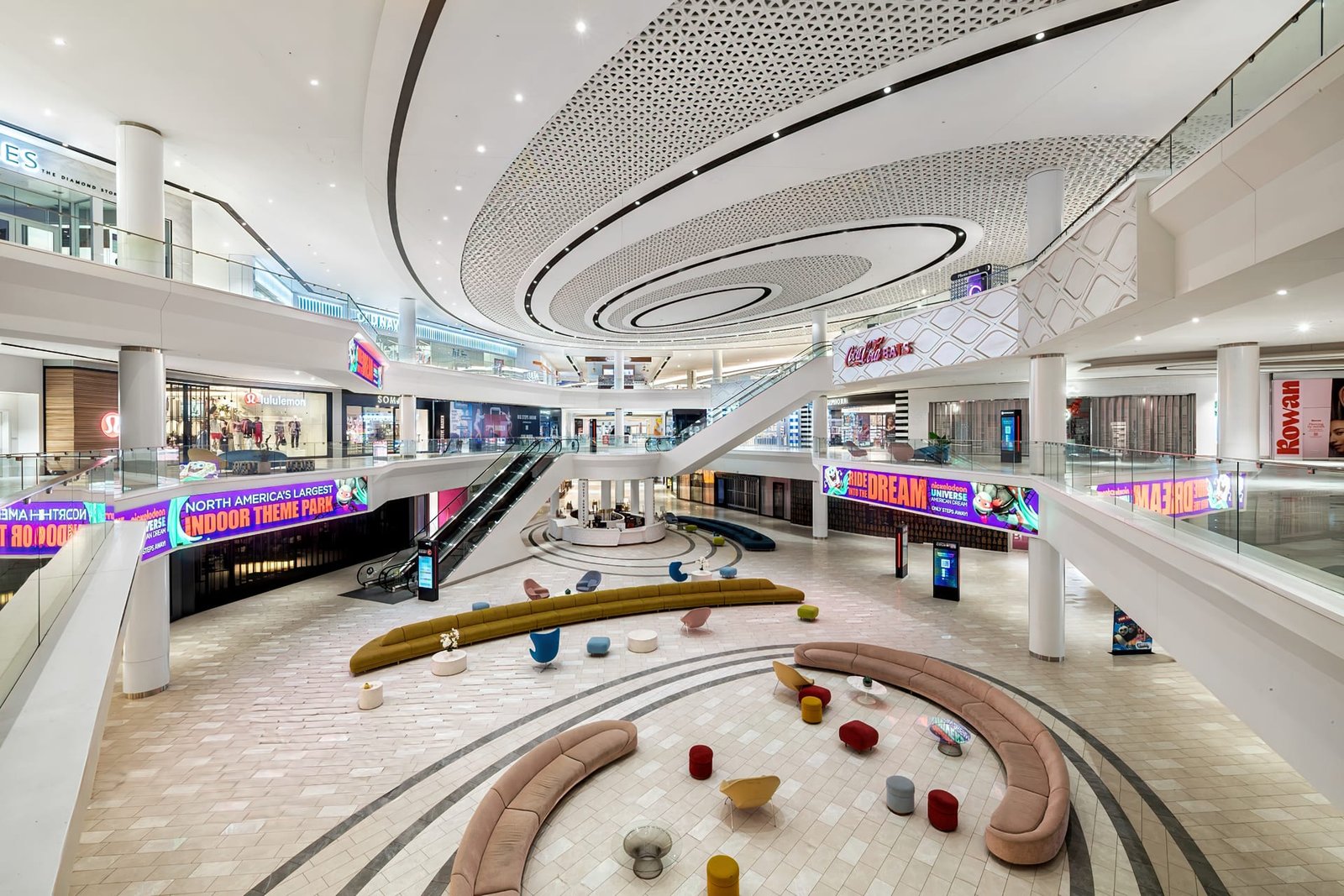
A room is a three-dimensional experience, yet a photograph is a flat plane. The tension between those two facts is where much of the craft of interior photography lives. When a space is well photographed, the eye does not stop at the surface of the image. It travels inward, moving from foreground to middle ground to the far wall, gathering a sense of volume along the way. This quality of travel is what we mean by depth, and it is one of the most reliable markers separating a competent record of a room from an image that genuinely conveys how it feels to stand inside it.
For architects and interior designers, depth is not a decorative flourish. It is the visual evidence of proportion, circulation, and the relationships you have carefully composed between one part of a room and another. A photograph that flattens those relationships quietly undoes months of design intent. A photograph that honours them lets the viewer read your spatial reasoning at a glance.
How Depth Is Built
Depth is not captured so much as constructed. It emerges from a handful of decisions made deliberately, most of them before the shutter is ever released.
Layering the Frame
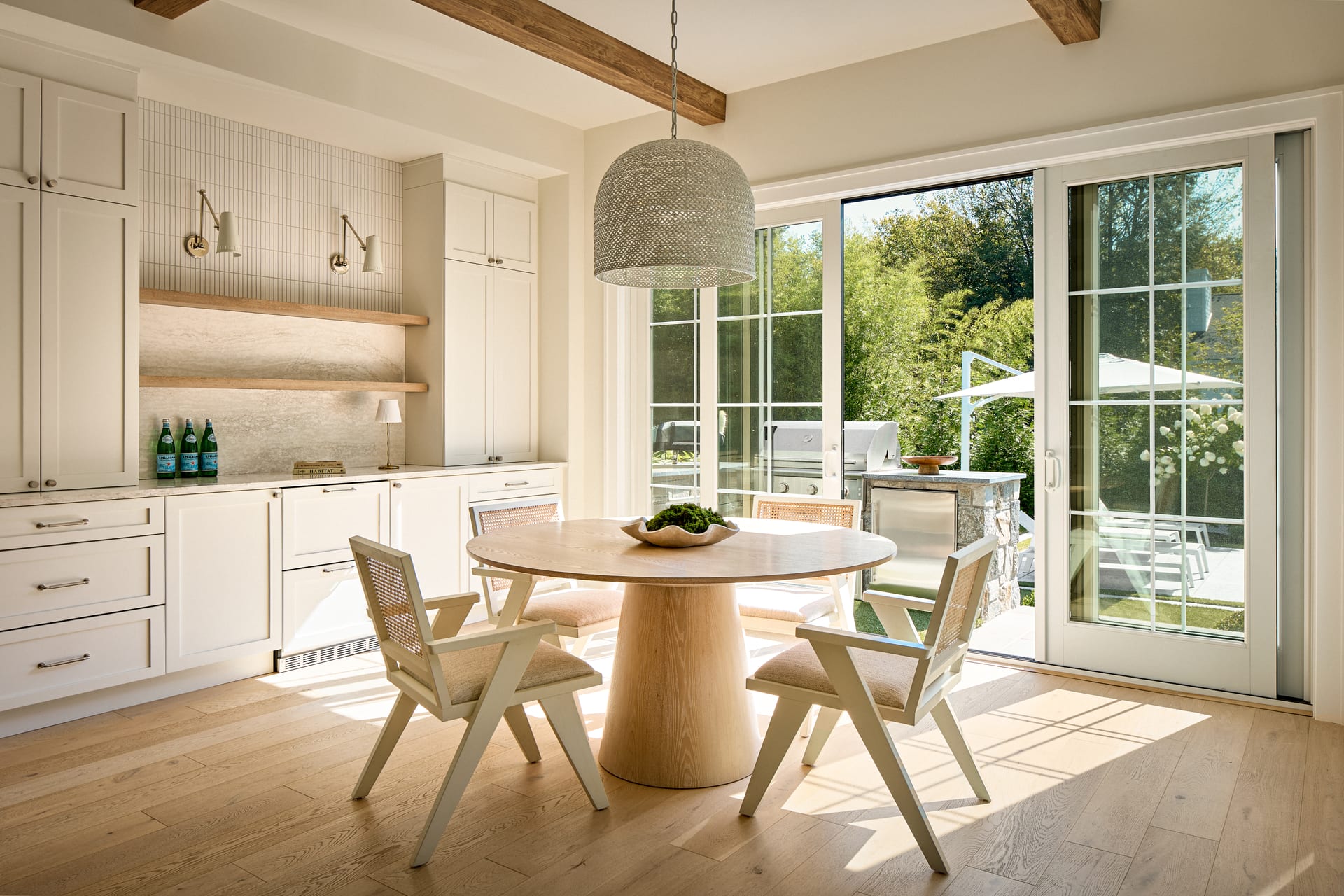
The clearest way to build depth is to give the eye a sequence of things to pass through. A foreground element close to the lens, a considered middle ground, and a resolved background create three distinct planes. The mind reads the interval between them as distance. In practice this might be the edge of a dining table in the foreground, a seating arrangement beyond it, and a window or doorway further back still. Each layer confirms that space exists between the last one and the next.
A photograph that flattens a room’s relationships quietly undoes months of design intent.
The mistake many make is to strip the foreground away in pursuit of tidiness. An unobstructed view feels safe, but it often reads as shallow. A room needs something near the camera to measure the rest against.
The Line That Leads
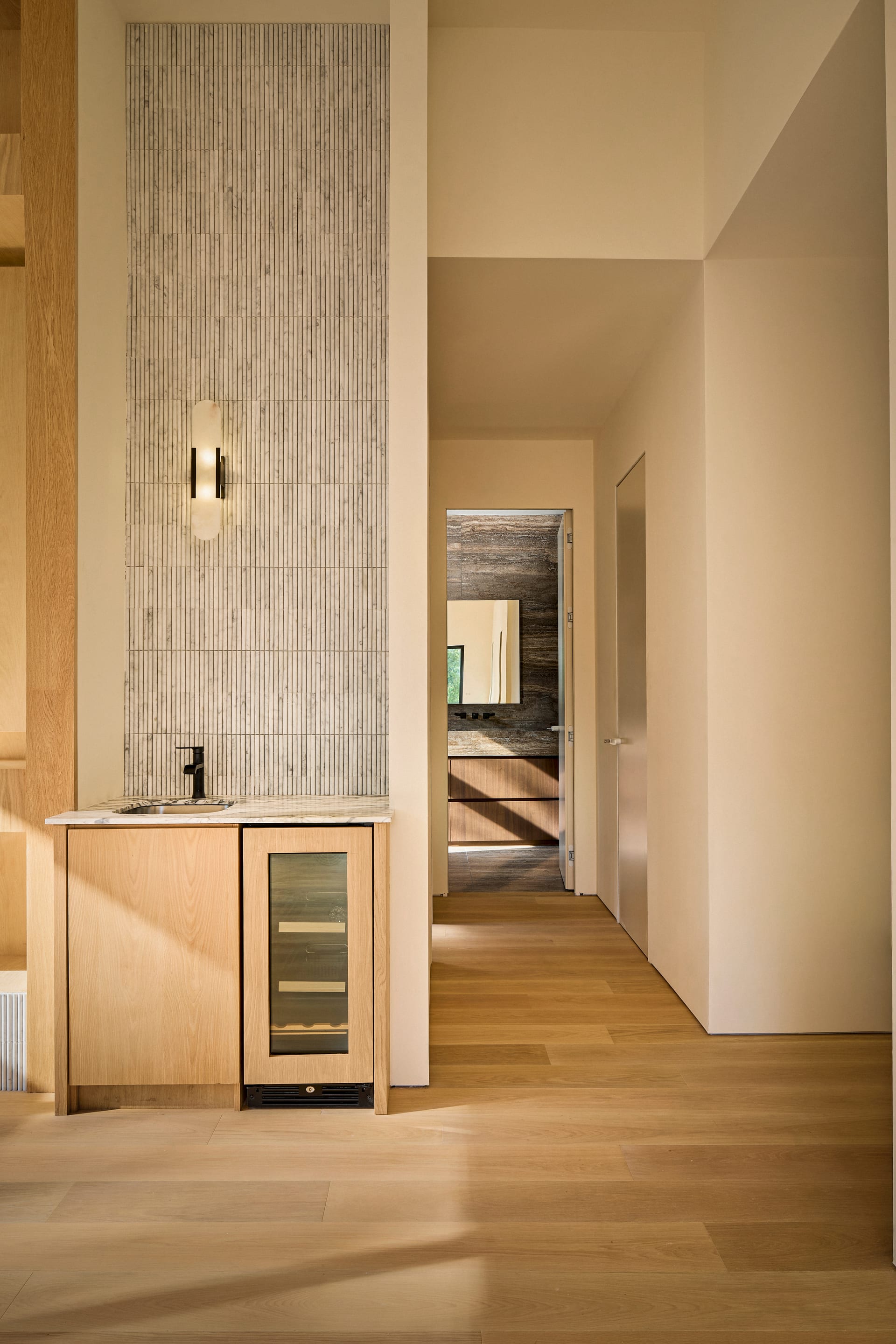
Architecture is generous with lines that draw the eye inward. Floorboards, the run of a countertop, a corridor, the coffered rhythm of a ceiling, the meeting of wall and floor. When these converge toward a point deep in the frame, they act as an invitation, pulling the viewer through the image. Positioning the camera so that strong lines gather toward a meaningful destination, rather than trailing off at an awkward edge, is one of the quietest and most powerful tools in architectural photography.
Framing Within the Frame
Doorways, arches, and openings offer a natural device: a frame inside the photograph. Shooting from one room through an opening into another establishes an immediate sense of passage. The threshold tells the viewer that they are looking from here to there, and that separation is itself a form of depth. Boutique hotels and layered residential interiors reward this approach, because their sequences of connected spaces are often the very thing that makes them memorable.
The Role of Light in Reading Distance
Depth is as much about tone as geometry. When every surface in a room sits at the same brightness, the planes collapse into one another. Variation restores them. A foreground held slightly darker than a sunlit far wall creates a gradient the eye reads as recession. Light falling across a space, rather than flatly upon it, gives objects a bright side and a shadowed side, and that modelling is what makes them feel solid.
This is why natural light, used with patience, tends to build depth so convincingly. It arrives at an angle, wraps around forms, and pools unevenly across a room. The photographer’s task is to time and shape the shot so that this uneven light works in service of the composition rather than against it.
- Let one plane fall into relative shadow so another can read as distant and bright.
- Use raking light across textured surfaces to reveal their form.
- Watch for a bright window at the far end of a view, which acts as a natural anchor point for the eye.
Choosing the Lens and the Distance
Focal length shapes the sense of depth as much as any other decision. A very wide lens exaggerates the distance between foreground and background, stretching the room and pushing the far wall away. This can be dramatic, but it distorts proportion and can make a modest space feel cavernous or a piece of furniture feel oddly enlarged. A longer lens compresses the planes, drawing the background forward and flattening the sense of travel.
Neither extreme is inherently correct. The judgement lies in matching the lens to the truth of the room. For interior photography that must represent a space honestly to a client or buyer, a moderate focal length usually serves best, offering enough width to include the layers without distorting the relationships between them. The camera position matters just as much: stepping back and using a slightly longer lens often reads more naturally than crowding in with a wide one.
A room needs something near the camera to measure the rest against.
Depth in the Service of the Design
For design professionals, the reason to care about all of this is straightforward. Depth is how a photograph communicates the thing that a floor plan cannot: the felt experience of moving through a space. A realtor benefits because a buyer can imagine walking from the kitchen toward the light of the garden beyond. A hotelier benefits because a guest can sense the calm of a lobby that recedes into a quiet lounge. An architect benefits because the spatial logic of a building becomes legible in a single frame.
A Short Checklist Before the Shutter
- Is there something in the foreground to anchor the near plane?
- Do the strongest lines lead toward a meaningful point, not an empty corner?
- Is there a frame within the frame, such as a doorway or opening?
- Does the light vary across the planes, or has it flattened into one tone?
- Does the focal length represent the room’s proportions honestly?
None of these questions requires elaborate equipment. They require attention, and the willingness to move around a room until its depth reveals itself rather than settling for the first comfortable angle. The best interior and architectural photographs are almost never taken from the doorway. They are found a few steps in, at the point where the room begins to open up in layers.
When depth is handled with intention, a photograph stops describing a room and begins to offer it. The viewer is no longer looking at a space; they are, for a moment, standing within it. That is the quiet ambition behind every considered frame.
If you would like your spaces photographed with this kind of attention to depth and dimension, we would be glad to hear from you at Matthew Lekker Photography.
Add us as a preferred source on Google
Add as preferred source